

Last updated: September 11, 2026
Rugged cliffs, fishing villages painted with every color, and ancient icebergs drifting past headlands. That's Newfoundland.
Summary
- The best things to do in Newfoundland include hiking Gros Morne National Park, exploring the colorful streets of St. John's, and watching icebergs from the land
- The best places to stay include boutique hotels in St. John's, historic inns on the Bonavista Peninsula, and Fogo Island Inn
- You can reach Newfoundland by flying into St. John's or Gander, or by taking the ferry from North Sydney, Nova Scotia
Things to do in Newfoundland span wandering colorful towns and cities, hiking cliffside trails, watching icebergs drift by, and trying the uniquely Newfoundland Jiggs dinner.
At Canada By Design, we think the best way is to do it all. Our Newfoundland itineraries split time between the small city atmosphere in St. John's, the grandiose scenery of Gros Morne, and the charming little towns and villages scattered along the coast. This is our expert's guide to visiting Newfoundland.
Our credentials? Over 25 years experience designing custom tours and itineraries throughout Canada, curating trips for every kind of traveler. We know what to do, when to do it, and how to arrange it into a life-changing vacation.
Each recommendation and suggestion is bookable as part of our personalized Canada itineraries. If you see something you like, reach out to a Travel Designer, and we can arrange it as a part of your trip. Now, let us show you around Newfoundland.
Things to Do in Newfoundland
The best things to do in Newfoundland include exploring authentic fishing towns, coastal and landlocked boat tours, hiking coastal trails, and exploring UNESCO World Heritage Sites. That means, if you're drawn to dramatic cliff scenery, maritime history, or the kind of warm, unfiltered hospitality Newfoundland is famous for, the island delivers.
 The Battery in St. John's | Credit: Destination Canada
Wander Historic Sites in St. John's
St. John's is the capital and largest city in Newfoundland & Labrador. When you first arrive in Newfoundland, you'll usually find yourself here. St. John's is the perfect introduction to Newfoundland's historic sites.
Some of the main historic sites in St. John's to visit are:
- The Battery
- Signal Hill National Historic Site
- Cabot Tower
- The Rooms museum
- Basilica of St. John the Baptist
You can see most of these on one walk. Starting downtown, hike through the historic Battery neighborhood to the North Head Trail, where you'll climb the northern side of the Narrows (with bonus views across to Fort Amherst on the south side) to Signal Hill National Historic Site. There, you can visit the Cabot Tower and watch the Noon Day Gun firing (or fire it yourself).
 Signal Hill National Historic Site in St. John's | Credit: Newfoundland and Labrador Tourism / Alex Buisse
The history here is palpable. The Battery has had many lives, first as a military post protecting the harbor, then as a fishing community, and now as a historic landmark and artistic hub. Cabot Tower received the first transatlantic wireless message in 1901.
Tickets to Signal Hill National Historic Site cost $10.00 per adult and $8.50 per senior as of 2026, but are included in itineraries from Canada By Design by default.
From Signal Hill, you can look over the city to spot the 19th-century Basilica of St. John the Baptist and the contemporary Rooms Museum, largely dedicated to Newfoundland & Labrador culture, on the other side. Both are well worth the visit.
More on St. John's later.
 A boat cruise on Western Brook Pond | Credit: Newfoundland and Labrador Tourism
Western Brook Pond Cruise in Gros Morne
Western Brook Pond in Gros Morne National Park is a vast glacier-carved landlocked fjord and is an absolutely stunning display of natural beauty.
The best way to explore it is, unsurprisingly, on a boat tour on which you voyage to the far end of the fjord, where it narrows to be entirely surrounded by dramatic cliffs and flat-topped mountains.
 A boat getting up close to an icebergs | Credit: Fogo Island Inn
Iceberg Boat Tour in Iceberg Alley
While icebergs come close enough to Newfoundland's coasts to be seen from land, the best way to see them is on a boat tour. On the water, you can get far closer to the icebergs, sometimes even close enough to hear them creaking as they move (which is a truly remarkable experience).
The icebergs arrive every spring and early summer, drifting south from Greenland to what's known as Iceberg Alley, on the eastern coast of Newfoundland.
We usually choose iceberg-watching boat tours and cruises in Twillingate, but tours also leave from St. John's further south.
 Cape Spear on Canada's easternmost coast | Credit: Newfoundland and Labrador Tourism / Dru Kennedy
Watch the Sunrise at Cape Spear
Cape Spear is the easternmost point in North America. There, you can look out over the uninterrupted Atlantic Ocean, see the first sunrise on the entire continent, and visit Cape Spear Lighthouse National Historic Site on the very same headland.
Visit L'Anse aux Meadows National Historic Site
L'Anse aux Meadows is the only confirmed Norse settlement in North America, making it a unique place to visit in Newfoundland, Canada, or otherwise. It's a little-known spot, perfect for anyone drawn to deep and largely forgotten histories and families looking to introduce children to the story of the Vikings' arrival in the New World (nearly five hundred years before Columbus did!).
L'Anse aux Meadows National Historic Site is located on the far northern tip of Newfoundland and isn't a place many visitors reach. However, we include it in our Newfoundland Discovery Road Trip, our favorite itinerary for travelers looking to explore Newfoundland from tip to tip.
 A whale watching tour passing by a humpback whale | Credit: Newfoundland and Labrador Tourism / O'Brien's Boat Tours
Whale Watching and Puffin Boat Tour
Whale watching boat tours in Newfoundland are not only a chance to see humpbacks, but also the Atlantic Puffins that make the coast their home.
Newfoundland & Labrador's coasts are home to the world's largest population of humpback whales, who return each year to feed, and around 95% of all North America's puffins, meaning it's one of the best places on Earth to see both in one trip. And, as you do, you'll get some stunning views back over the land to see colorful houses and clapboard fishing villages lining the shore. The best time for a whale watching tour in Newfoundland is between May and September, when the humpbacks return to feed, and the puffins nestle on the cliffs to breed.
 Wild berry picking at Fogo Island Inn | Credit: Destination Canada
Eat Local Dishes
Newfoundland has some of the most unique traditional dishes in Canada, bolstered by a variety of fresh local seafood, game meat, and berries. It means that, in Newfoundland, you'll find foods you can't try anywhere else. Local seafood chowder and fish and chips are obvious choices. But others, like a Jiggs Dinner, cod tongues, toutons, and Partridgeberry jam tarts, are distinct to Newfoundland.
 People picnicking together on Newfoundland's coast | Credit: Newfoundland and Labrador Tourism / Dru Kennedy
Meet the People
Not to be cliche, but the local people are really what makes Newfoundland as special as it is. They're everywhere, of course, but we'd recommend visiting local pubs, family-run businesses, and small inns and boutique hotels along your trip. This is where you'll find the small-town friendliness that spreads across the entire island.
Places to Visit in Newfoundland
Some of the best things to do in Newfoundland are less 'things to do' and more places to visit. Newfoundland is as special as it is because of the tight-knit atmosphere that's spread throughout the island.
 St. John's colorful skyline | Credit: Barrett and MacKay
St. John's
Like we said earlier, St. John's is the best place to start any Newfoundland adventure.
Downtown, George Street, Water Street, and Jellybean Row offer a mix of history and contemporary culture. These streets are lined with 19th-century buildings and absolutely bustling with life. On George Street, that looks like brick pubs and bars, and on Water Street, gift shops and bakeries. Jellybean Row, on the other hand, consists of wooden clapboard houses throughout downtown, each painted a different pop of color.
Many activities that people consider old-fashioned continue to be alive and well here. Pub culture is thriving, with many playing live music year-round — our team likes Shamrock City for nightly performances from local artists — packed out with locals and visitors. Most of our itineraries begin their Newfoundland portion here, and it's a fantastic central location to use as a jumping-off point for exploring the rest of the Avalon Peninsula.
 Quidi Vidi Brewery in the quiet Quidi Vidi neighborhood | Credit: Newfoundland & Labrador Tourism / Quidi Vidi Brewery
Quidi Vidi
Just a few minutes from downtown St. John’s, Quidi Vidi is a working fishing village home to a small harbor, a handful of fishing sheds, and Quidi Vidi Brewery, where you can sample a local beer before wandering the shoreline.
 Western Brook Pond in Gros Morne National Park | Credit: Newfoundland & Labrador Tourism / Barrett & Mackay
Gros Morne National Park
Gros Morne National Park is a UNESCO World Heritage Site, the largest national park in Atlantic Canada, and an absolutely stunning area made up of a number of startlingly different and striking sites throughout the national park.
Gros Morne is actually the northernmost tip of the truly ancient Appalachian Mountains. That history is clearly visible everywhere you look. It’s the pinnacle of natural beauty in Newfoundland & Labrador, and visible from various points across the park.
The best sites to visit in Gros Morne National Park are:
- The Tablelands
- Western Brook Pond
- Gros Morne Mountain
 The Tablelands in Gros Morne National Park | Credit: Newfoundland & Labrador Tourism
The Tablelands are made up of rust-colored exposed mantle rock, an extremely rare phenomenon. To visit the Tablelands, you should head to the southwest of Gros Morne National Park, between Trout River and Woody Point (both towns in the park).
Western Brook Pond is less a pond and more a vast landlocked fjord tucked between sheer, flat-topped cliffs and only accessible by walking a 2-mile trail to the tip of the water (though a shuttle service is available at an extra cost). From there, boat tours can take you out onto the fjord. More information is above under 'Western Brook Pond Boat Tour'.
Gros Morne itself is a domed mountain between Norris Point and Rocky Harbour towns and visible from the road connecting the two. The Gros Morne Mountain trail is long, a 10.5-mile return, and difficult, climbing 3,280 feet to the summit. We would only recommend the route to extremely experienced hikers. Others can view the peak from the Viking Trail road.
 Iceberg watching near Twillingate | Credit: Newfoundland & Labrador Tourism
Twillingate
Tillingate is one of Newfoundland's most scenic coastal communities, known for its cliffs, colorful houses, and icebergs. Due to its position along Iceberg Alley, it is especially fruitful for iceberg viewing, as icebergs drift down from Greenland in spring and early summer. We include an iceberg-watching cruise here in our Newfoundland itineraries. On these cruises, you'll also have the chance to see humpbacks, puffins, seabirds, and the colorful towns from the water.
Twillingate is just over a 5-hour drive from St. John's.
 Trinity town on Bonavista Peninsula | Credit: Destination Canada
Bonavista and Trinity | Bonavista Peninsula
Bonavista and Trinity are two more gorgeous little towns along Newfoundland's eastern coast, this time just a three-and-a-half-hour drive from St. John's on the Bonavista Peninsula. Both are utterly charming towns but, despite being close together, have distinct personalities. Trinity is protected in a natural cove and is lush and vibrant as a result. Visit Trinity for its historic clapboard houses, many of which you can tour.
 Bonavista on the Atlantic Ocean | Credit: Newfoundland & Labrador Tourism / Dru Kennedy
Bonavista, on the other hand, is on a headland jutting out into the Atlantic Ocean. It's larger than Trinity and has a number of pubs, bakeries, tea rooms, and breweries downtown (along Church Street), and a number of incredible attractions surrounding the town. For natural sights, visit Dungeon Provincial Park (a UNESCO Geosite) to see into a collapsed sea cave and arch, Elliston puffin viewing site, one of the best places in North America to view puffins from land, and the Chimney at Spillars Cove (another UNESCO Geosite) for incredible rock formations along the coast.
For historic sites, visit Matthew Legacy, a replica of John Cabot’s ship connected to his 1497 Atlantic voyage, Ryan Premises National Historic Site, and Cape Bonavista Lighthouse, a red-and-white striped lighthouse overlooking a puffin colony island.
 Fogo Island's iconic skyline | Credit: Fogo Island Inn
Fogo Island
Fogo Island is a remote outport island off Newfoundland's eastern shore. It's made up of a juxtaposition of traditional small fishing communities, still working and operating, and strikingly modern artist studios.
Fogo Island was made globally famous in 2013 when the ultra-luxurious, architecturally extraordinary Fogo Island Inn was built. The inn remains one of the most beautiful hotels in the world, winning all manner of awards. But what makes it truly special is the place it stands.
If you can make the journey there, Fogo Island should be high on any list of Newfoundland itineraries.
 Artisan Inn in Trinity, Newfoundland | Credit: Artisan Inn
Where to Stay in Newfoundland
The best places to stay in Newfoundland range from modern boutique hotels and historic inns to Fogo Island Inn, a luxury inn at the edge of the Earth which combines the two.
Across Newfoundland, we try to lean into the province's history and charm, choosing locally-run historic inns that reflect the place they're found. Some favorites are:
- Artisan Inn, Trinity
- Leaside Manor, St. John's
- Harbour Lights Inn, Twillingate
- Neddies Harbour Inn, Gros Morne National Park
However, when choosing hotels, we center our choices around our guests, making sure their needs and comfort come first. Especially in bigger hubs like St. John's, more modern and boutique options are available.
 Fogo Island Inn on Fogo Island, Newfoundland | Credit: Fogo Island Inn
Luxury Hotels in Newfoundland
For a luxury vacation in Newfoundland, there is no place better than Fogo Island Inn, the Three MICHELIN Key-winning, Condé Nast Traveler Triple Crown-holding, stilted luxury retreat on Fogo Island.
Related Post
Fogo Island Inn: Luxury Regenerative Travel
Experience one-of-a-kind luxury at Fogo Island Inn, where stunning landscapes and exceptional hospitality bring high-end regenerative travel to Canada..
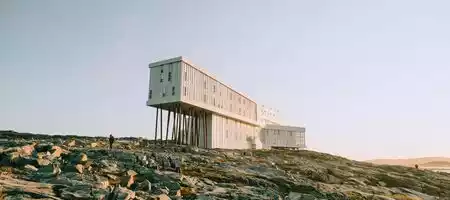
There aren't enough words to describe Fogo Island Inn, which is both strikingly modern and deeply committed to its roots. Each room contains traditionally hand-crafted furniture (all available for purchase) contrasted by floor-to-ceiling windows. Meals are delicately plated and sustainably sourced from as close to the island as possible. Activities are as lavish as helicopter tours and whale watching, and as personal as a local community host introducing you to their home. That contrast and endless commitment to the wellbeing of the island communities make Fogo Island Inn like no other hotel in Canada.
How to Get to Newfoundland
There are two ways to get to Newfoundland: by plane or by ferry.
Getting to Newfoundland by Plane
There are three airports in Newfoundland you can arrive in:
- St. John's International Airport (YYT)
- Deer Lake Regional Airport (YDF) for Gros Morne
- Gander International Airport (YQX) for trips to Twillingate and Fogo Island
The best airport to arrive at depends on where you'll be visiting. If you're working with us, the recommended arrival and departure airports are included in your itinerary by default.
We usually begin our itineraries from St. John's International Airport because it acts as a great central hub from which to explore eastern Newfoundland. But we use Deer Lake Regional Airport and Gander International Airport to access more remote places, in particular Fogo Island Inn.
It's worth noting that most international travelers will require a layover at a major Canadian airport, usually Toronto Pearson (YYZ) or Montreal-Trudeau (YUL), before connecting to Newfoundland. That being said, arriving by plane is still the best option for visitors traveling directly to Newfoundland from the USA or from further afield.
Getting to Newfoundland by Ferry
Newfoundland connects to mainland Nova Scotia via the Marine Atlantic ferry, with year-round service between North Sydney, Nova Scotia, and Port aux Basques, on Newfoundland's southwest coast. The route takes around six to seven hours and can either be done in the day, for grand Atlantic views, or overnight to take less time away from exploration.
The ferry is the best option to get to Newfoundland from the rest of Atlantic Canada. We include a ferry crossing with reserved seating in our own itineraries connecting Newfoundland to other Atlantic provinces. Reserved seating is typically optional for travelers, but we find that a reliable seat in a quiet area of the ship makes for the most comfortable crossing for our guests. You'll be free to wander the ship as you please during the journey to make the most of outdoor decks, onboard eateries and restaurants, and gift shops.
Getting to Newfoundland by ferry is best when your trip to Canada includes both Newfoundland and time in other provinces.
Top Packages with Time in Newfoundland
Coastal Quest | Atlantic Canada Road Trip
On our most comprehensive Atlantic Canada itinerary, you’ll spend 18 days touring Atlantic Canada by car. You’ll journey through New Brunswick, Nova Scotia, and Prince Edward Island before ending the trip with eight days exploring Newfoundland, bottom to top.
Newfoundland Discovery | Atlantic Canada Road Trip
Spend two weeks exploring Newfoundland, driving from St. John’s in the south to L’Anse aux Meadows on the far northern tip. Along the way, you’ll see colorful cities, quaint villages, a landlocked fjord, ancient icebergs, and more.
Best of Newfoundland East
On this once-in-a-lifetime trip, arrive in St. John’s to get acquainted with Newfoundland’s charm — wander the colorful streets, picnic by the lighthouse, or hike the clifftop trails — before boarding a private helicopter bound for Fogo Island. There, spend four days unwinding in absolute luxury at the Three MICHELIN Key-winning Fogo Island Inn.
 The Canada By Design team exploring Newfoundland | Credit: Canada By Design
How to Book
When booking with Canada By Design, we take care of the necessities, arranging your hotel stays, transport, and activities ahead of time. A Travel Designer will work with you one-on-one to include the best activities for you and weave them into a custom itinerary. When the time comes, you just have to show up.
Begin Your Journey Today
Connect with one of our Travel Designers to begin designing your trip. Ready for your dream adventure?
FAQs
How do I get to Newfoundland?
The best ways to get to Newfoundland are either to fly directly to St. John's International Airport or to take the Marine Atlantic ferry from North Sydney, Nova Scotia.
What's the best time to visit Newfoundland?
The best time to visit Newfoundland is between June and September, when seasonal attractions are open and the weather is at its best. Within that time, late May and June are best for iceberg viewing, July and August are best for warm-weather hiking, while August and early September are best for whale watching and mild coastal weather.
Feature Image Credit: Newfoundland and Labrador Tourism
Table of Contents
- Things to Do in Newfoundland
- Wander Historic Sites in St. John's
- Western Brook Pond Cruise in Gros Morne
- Iceberg Boat Tour in Iceberg Alley
- Watch the Sunrise at Cape Spear
- Visit L'Anse aux Meadows National Historic Site
- Whale Watching and Puffin Boat Tour
- Eat Local Dishes
- Meet the People
- Places to Visit in Newfoundland
- St. John's
- Quidi Vidi
- Gros Morne National Park
- Twillingate
- Bonavista and Trinity | Bonavista Peninsula
- Fogo Island
- Where to Stay in Newfoundland
- How to Get to Newfoundland
- Top Packages with Time in Newfoundland
- Coastal Quest | Atlantic Canada Road Trip
- Newfoundland Discovery | Atlantic Canada Road Trip
- Best of Newfoundland East
- How to Book
Related Posts
Things to Do in Nova Scotia: Travel Experts' Guide
We gathered the best advice from our in-house travel experts to bring you our comprehensive guide to visiting Nova Scotia in Atlantic Canada.

Things to Do in Prince Edward Island: Travel Experts' Guide
We gathered the best advice from our in-house travel experts to bring you our comprehensive guide to visiting Prince Edward Island in Atlantic Canada.

Canada Winter Vacation: The Canadian Rockies by Train
Explore our best-selling winter vacation in Canada: a snowy sleeper train to the Canadian Rockies.