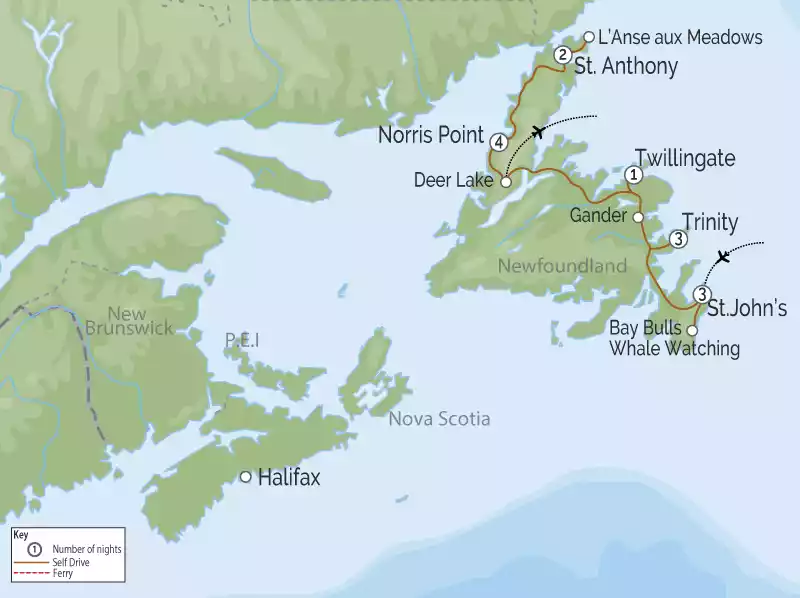
Day 1 Halifax | Arrival
Arrive in Halifax and check in to your accommodation, ideally located in the downtown core of Nova Scotia’s vibrant capital city. Set on one of the world’s great natural harbours, Halifax blends maritime history, lively waterfront energy and East Coast charm. Spend time strolling the harbourfront boardwalk, where museums, restaurants, galleries and historic buildings look out over the water, or explore the city’s steep streets, heritage neighbourhoods and welcoming pubs. With fresh seafood, local craft breweries, live music and a rich seafaring past, Halifax offers a memorable introduction to Atlantic Canada.
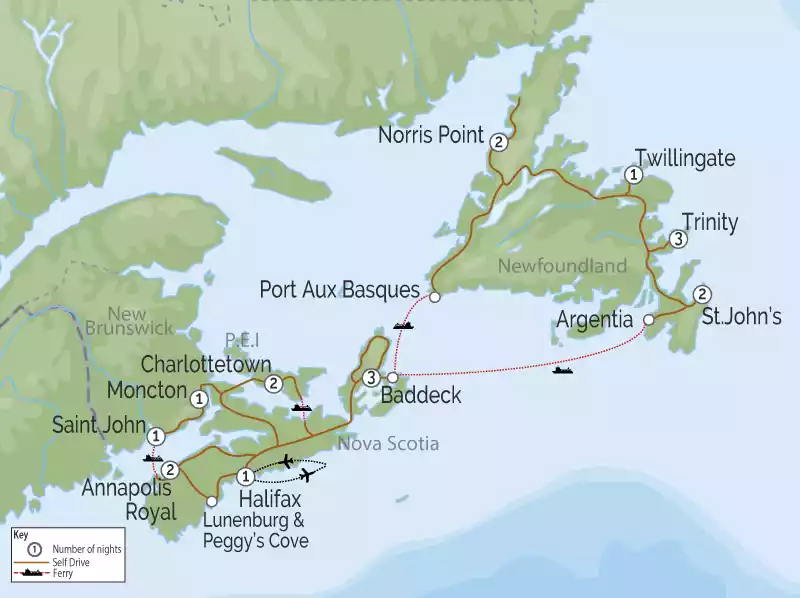
Day 2 Halifax to Annapolis Royal or Smith’s Cove | 281 km/175 mi
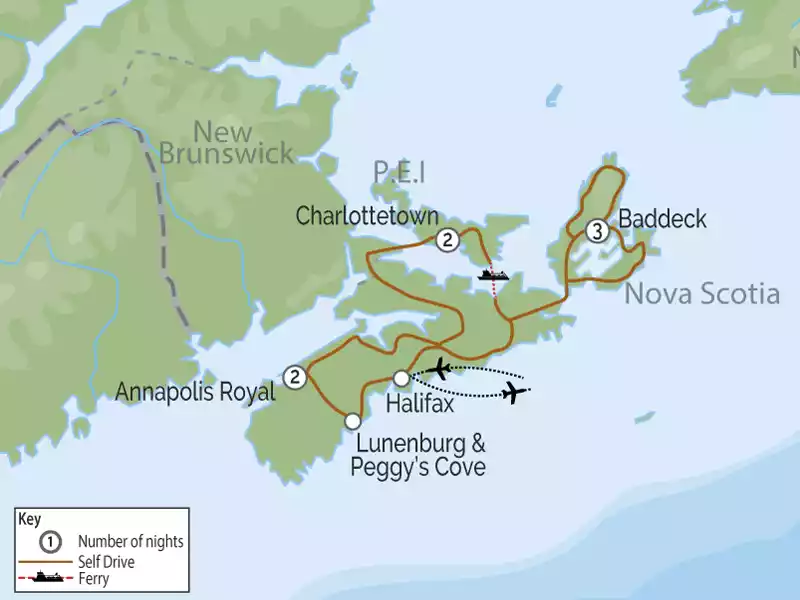
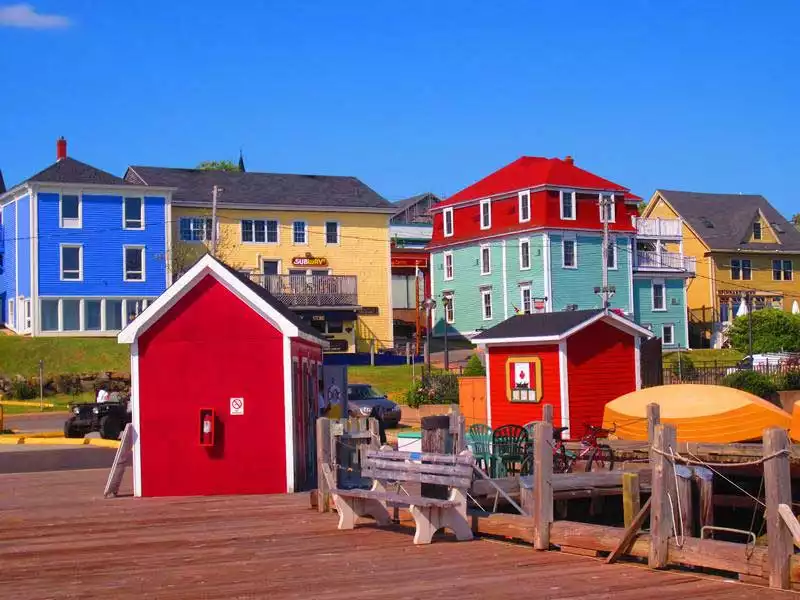
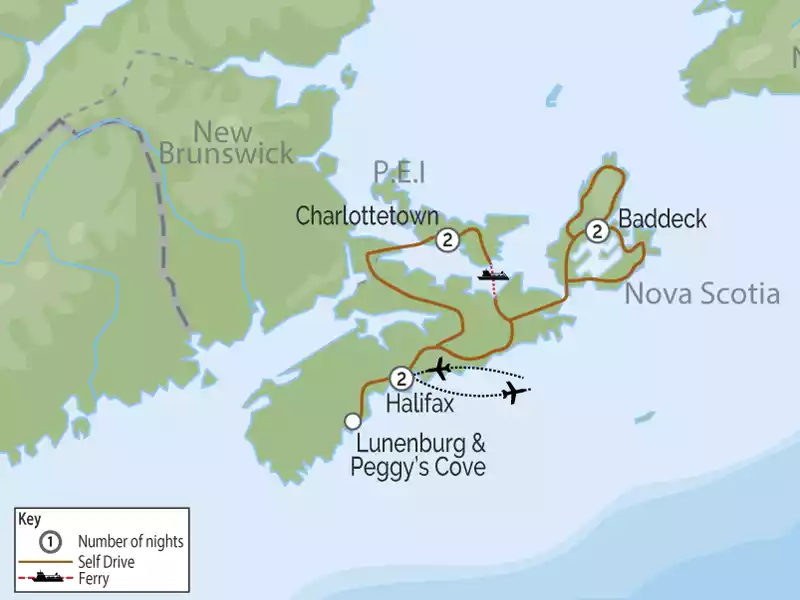
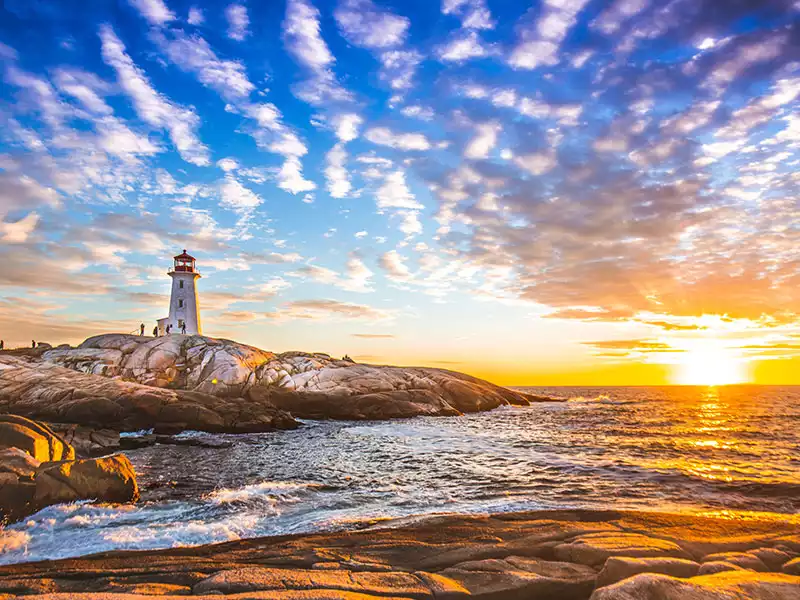
Depart Halifax and travel along Nova Scotia’s scenic South Shore toward Peggy’s Cove, one of the province’s most iconic coastal villages. Here, colourful houses sit against wave-worn granite and the famous lighthouse looks out over the Atlantic Ocean. Continue to Old Town Lunenburg, a UNESCO World Heritage Site known for its colourful waterfront, beautifully preserved architecture and rich seafaring heritage. Time permitting, continue inland to Kejimkujik National Park and National Historic Site, renowned for forest trails, wilderness lakes, canoe routes and deep Mi’kmaw cultural history. Arrive in Annapolis Royal, or nearby Smith’s Cove, set close to the Bay of Fundy and surrounded by historic charm, coastal scenery and peaceful maritime landscapes.
Day 3 Whale Watching & Fishing Villages Exploring | 206 km/128 mi
Travel toward Digby Neck and the Bay of Fundy, where nutrient-rich waters create one of Atlantic Canada’s most rewarding whale watching regions. Depending on your departure point and tour location, allow time for the drive and any required ferry connections to reach the whale watching area. Set out in search of humpback, fin, minke and other whale species, with the possibility of seabirds, seals and dramatic Fundy coastal scenery along the way. In the afternoon, return to explore Annapolis Royal and Fort Anne, where centuries of Acadian, Mi’kmaw, French and British history are reflected in the town’s heritage buildings, waterfront setting and historic grounds.
Day 4 Smith’s Cove or Annapolis Royal to Saint John | approx. 40 km/25 mi + Ferry
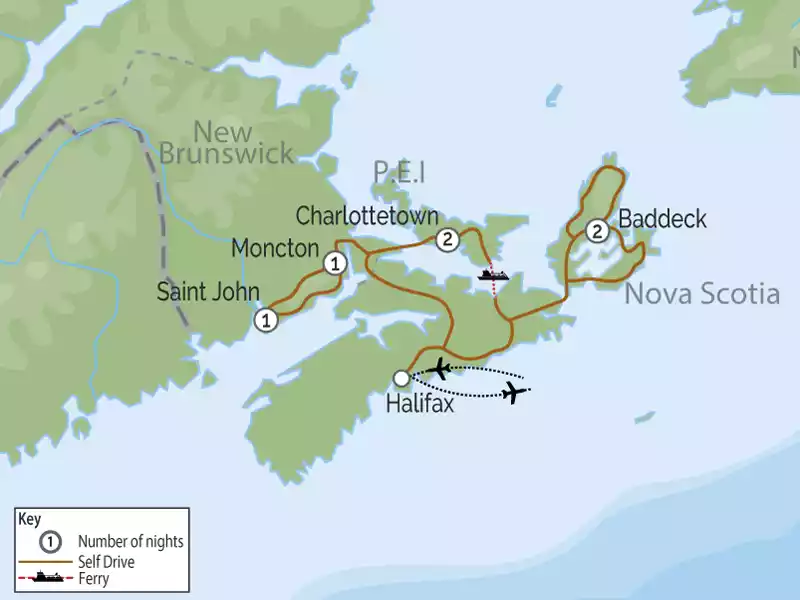
Depart the Annapolis Royal area and travel to Digby to board the ferry across the Bay of Fundy to Saint John, New Brunswick. This scenic crossing offers a relaxed way to experience the vast waters of the Bay of Fundy before arriving on New Brunswick’s southern coast. Saint John is famous for the Reversing Falls Rapids, where the powerful tides of the Bay of Fundy meet the Saint John River, creating a dramatic natural tug-of-war that changes direction with the tide. Spend time exploring the waterfront, historic streets and coastal character of Canada’s first incorporated city.
Day 5 Saint John to Moncton via Fundy Trail & Hopewell Rocks | 212 km/131 mi
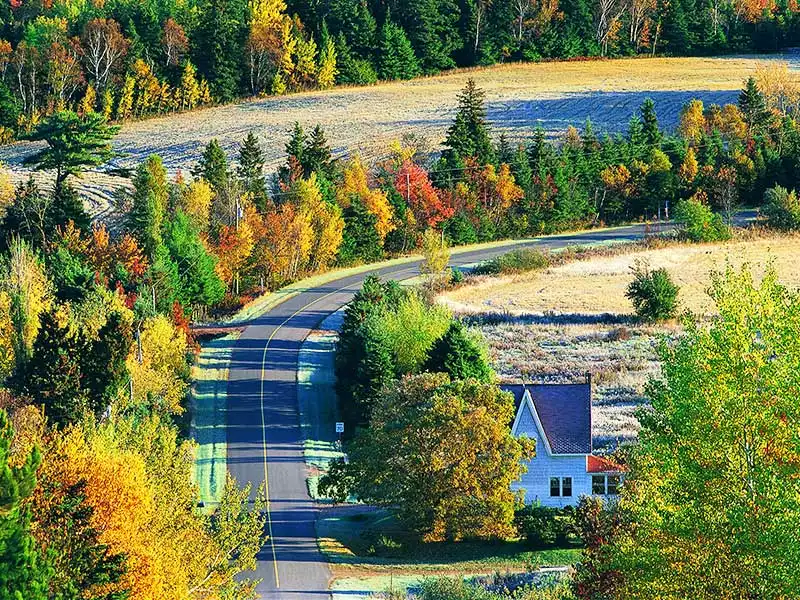
Today’s drive showcases the dramatic coastline, natural wonders and maritime heritage of southern New Brunswick. Travel through the Fundy Trail Parkway, where coastal lookouts, waterfalls, forest trails and rugged Bay of Fundy scenery create one of the province’s most rewarding drives. Recommended stops include the Big Salmon River area, Walton Glen Gorge, Fuller Falls, Long Beach and scenic viewpoints overlooking the Fundy coastline.
Continue through Fundy National Park and the village of Alma, a great place to enjoy fresh seafood and views of Shepody Bay, before visiting Hopewell Rocks. Here, massive flowerpot sea stacks rise from the ocean floor, offering a remarkable look at the power of the world-famous Fundy tides. After visiting the rocks, continue toward Moncton. If time permits, stop at Magnetic Hill, where a curious optical illusion makes vehicles appear to roll uphill.
Day 6 Moncton to Charlottetown | 164 km/101 mi
Depart Moncton and travel toward Prince Edward Island, with the option to stop in Shediac, known as the “Lobster Capital of the World.” Learn about the town’s fishing heritage, enjoy its coastal atmosphere and see the iconic World’s Largest Lobster sculpture before continuing toward the Confederation Bridge. This impressive 12.9 km bridge spans the Northumberland Strait and provides a memorable gateway to Prince Edward Island. Arrive on PEI and continue through rolling farmland, red earth, coastal views and small island communities to Charlottetown, the charming capital of Prince Edward Island.
Day 7 Charlottetown & Prince Edward Island | Exploring
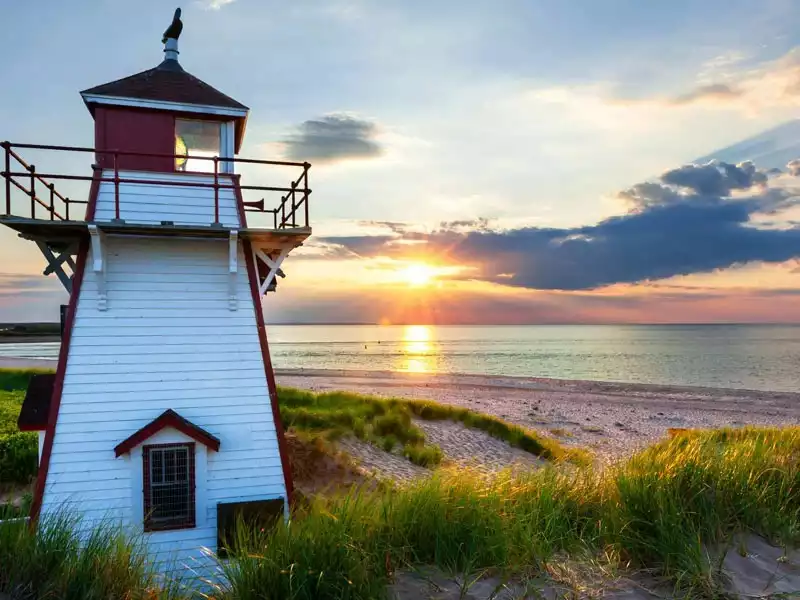
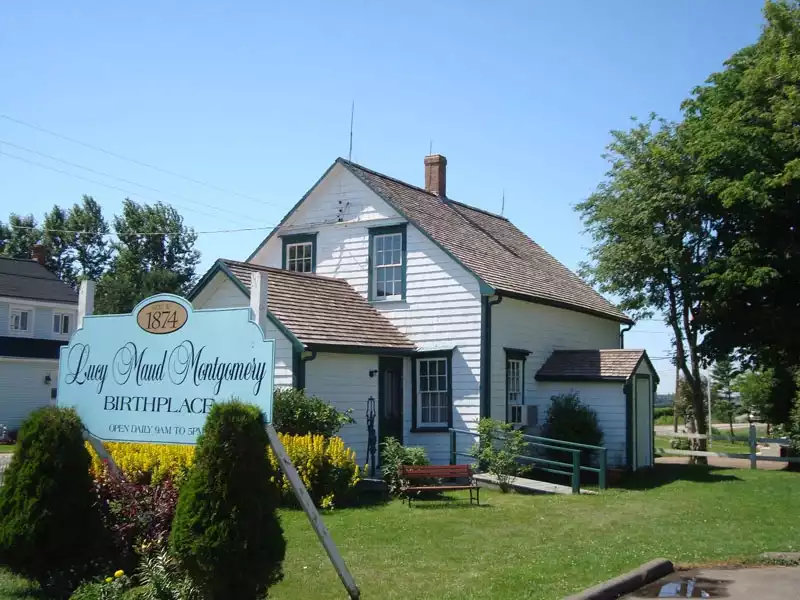
Spend the day exploring Prince Edward Island’s classic coastal scenery, where red cliffs, white sand beaches, gentle dunes and green fields create one of Canada’s most distinctive island landscapes. Travel to Prince Edward Island National Park for views of the Gulf of St. Lawrence, sandy shoreline and protected dunes, then continue to Green Gables Heritage Place in Cavendish. This beloved literary landmark celebrates L.M. Montgomery and the landscapes that inspired Anne of Green Gables, a story loved by readers around the world. Return to Charlottetown with time to enjoy its historic streets, waterfront restaurants and relaxed island atmosphere.
Day 8 Charlottetown to Baddeck | 274 km/170 mi + Ferry
Depart Charlottetown and travel east to Wood Islands for the scenic ferry crossing across the Northumberland Strait to Caribou, Nova Scotia. After arriving on the mainland, continue to Pictou, where Hector Heritage Quay tells the story of early Scottish settlement and features a full-scale replica of the Ship Hector. From here, travel east across Nova Scotia and continue over the Canso Causeway to Cape Breton Island, a region known for its Gaelic and Celtic heritage, coastal scenery and strong musical traditions. Arrive in Baddeck, a scenic village overlooking the beautiful Bras d’Or Lake.
Day 9 Cabot Trail Touring | 298 km/186 mi
Set out to experience the Cabot Trail, one of Canada’s most celebrated scenic drives. The route winds around Cape Breton’s rugged northern coast and through Cape Breton Highlands National Park, where mountains rise above the Gulf of St. Lawrence and ocean lookouts reveal sweeping views of cliffs, forests and shoreline. Have your camera ready for dramatic coastal vistas, highland scenery and fishing villages tucked between sea and mountain. Time permitting, consider a walk on the Skyline Trail, one of the park’s most famous hikes, with panoramic views over the coastline and surrounding highlands.
Day 10 Baddeck to North Sydney + Overnight Ferry to Argentia, Newfoundland | 58 km/36 mi + Ferry
Enjoy a leisurely day in Cape Breton before travelling to North Sydney for your overnight Marine Atlantic ferry crossing to Argentia, Newfoundland. Settle into your included private stateroom for a comfortable night onboard. As the ferry sails across the Cabot Strait and into the open waters between Nova Scotia and Newfoundland, enjoy sea views, watch for seabirds and keep an eye out for possible marine-life sightings. This overnight voyage provides a relaxed transition from Cape Breton to Newfoundland’s Avalon Peninsula.
Day 11 Argentia to St. John’s | 134 km/83 mi
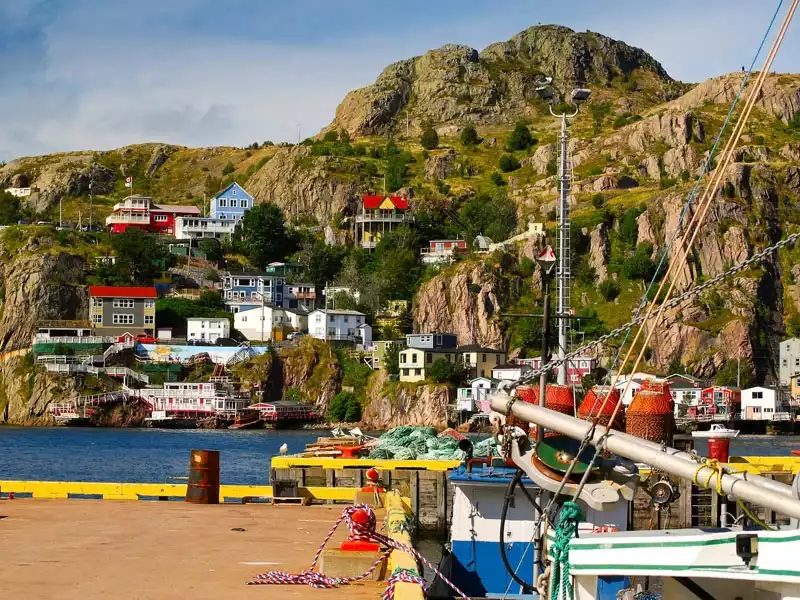
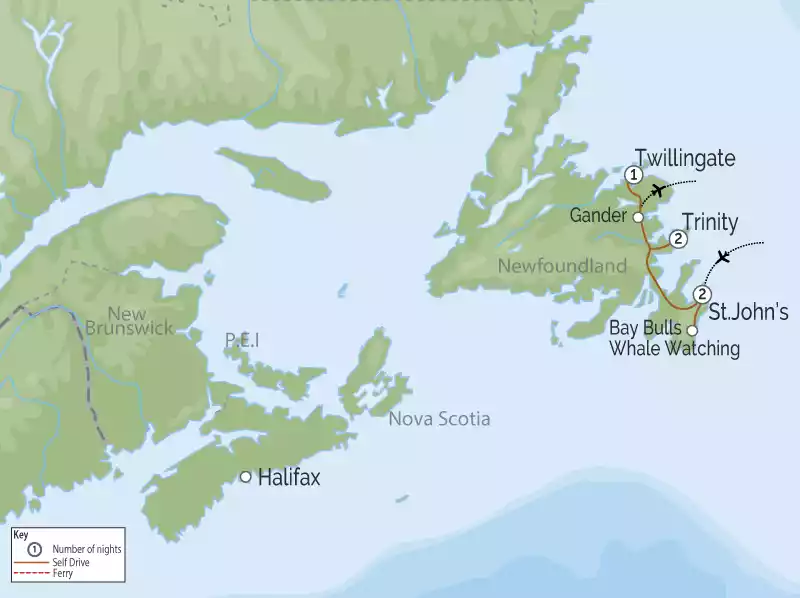
Arrive in Argentia and travel across Newfoundland’s Avalon Peninsula toward St. John’s. The route introduces the island’s rugged coastal beauty, with forested landscapes, fishing communities, ocean views and quiet stretches of countryside along the way. Continue to St. John’s, Newfoundland and Labrador’s colourful capital city, known for its steep streets, brightly painted row houses, lively waterfront and dramatic harbour setting.
Day 12 St. John’s | Exploring
Spend the day exploring St. John’s and its dramatic coastal surroundings. Visit The Rooms, Newfoundland and Labrador’s striking museum, gallery and archives, then continue to Signal Hill for sweeping views over the harbour, the Narrows and the Atlantic coastline. Travel to Cape Spear Lighthouse National Historic Site, the most easterly point of land in North America, where rugged cliffs, ocean views and historic lighthouse scenery create a powerful Atlantic setting.
Time permitting, visit Quidi Vidi Village, one of the city’s most photographed neighbourhoods, set around a sheltered harbour just minutes from downtown. You may wish to stop at Quidi Vidi Brewery for a pint of locally brewed beer before returning to St. John’s for the evening.
Day 13 St. John’s to Trinity | 269 km/167 mi
Depart St. John’s and travel toward the Bonavista Peninsula, a region known for rugged coastlines, historic outports and some of Newfoundland’s oldest communities. The journey follows changing landscapes of forests, bays, coastal inlets and small fishing villages before arriving in Trinity, one of the province’s most atmospheric historic towns. Before settling into your accommodation, you may wish to continue to New Bonaventure to visit the Random Passage Site. Built for the television miniseries Random Passage, the site offers a powerful sense of what life may have been like in a remote Newfoundland fishing outpost in the early 1800s.
Day 14 Trinity | Exploring
Spend the day exploring the enchanting village of Trinity, where restored white and pastel-coloured clapboard houses line a sheltered harbour framed by dramatic coastal scenery. Wander through preserved historic buildings and experience the village’s deep connection to Newfoundland’s fishing and merchant history. When available, join the Trinity Pageant, a walking theatre performance that brings local stories and history to life. If you are feeling active, hike the short but steep trail up Gun Hill behind the village for sweeping 360-degree views over Trinity, the harbour and the surrounding coastline.
Day 15 Bonavista Peninsula | approx. 130 km/81 mi
Venture to Port Rexton to hike the Skerwink Trail, one of Newfoundland’s most celebrated coastal walks. This scenic loop follows rugged headlands, sea stacks and ocean viewpoints, with views across the surrounding villages and coastline. In the afternoon, continue north to Bonavista, where Ryan Premises National Historic Site tells the story of Canada’s east coast fishery and the communities shaped by the cod trade. Nearby, visit the red and white Cape Bonavista Lighthouse and the Matthew Legacy, a replica of John Cabot’s ship connected to his 1497 Atlantic voyage.
Near Bonavista, stop at Dungeon Provincial Park, where the sea has carved a collapsed sea cave into a striking natural arch. Be sure to visit Elliston, one of the best places in North America to view puffins from land, where birds often nest and fly close to the rugged cliffs in season.
Day 16 Trinity to Twillingate + Iceberg Watch Cruise | 309 km/192 mi
Travel from the Bonavista Peninsula toward Twillingate, passing through the natural landscapes of Terra Nova National Park along the way. This beautiful park is known for sheltered inlets, boreal forest, quiet ponds and walking trails, offering a scenic place to pause and enjoy Newfoundland’s wilderness. In Gander, consider a stop at the North Atlantic Aviation Museum, which shares the town’s important role in transatlantic aviation history, from early flight routes to the events that inspired Come From Away.
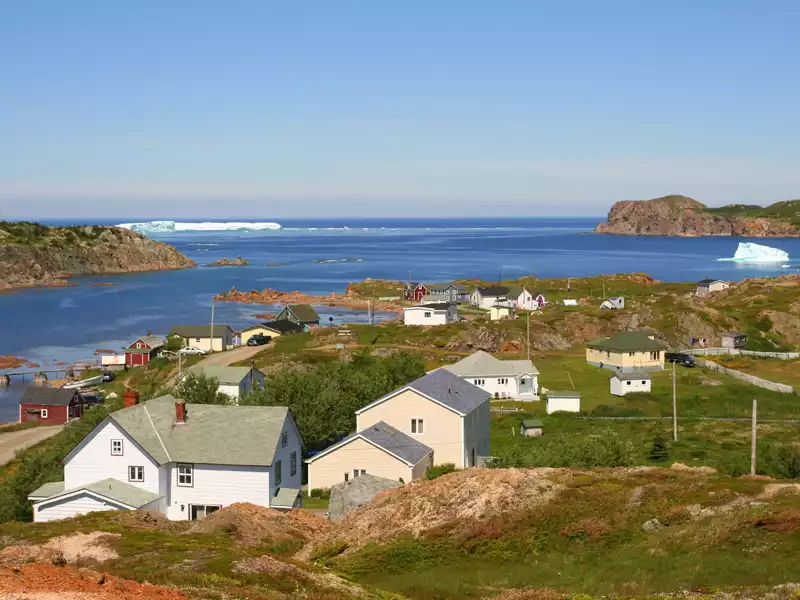
Continue toward Boyd’s Cove and the Beothuk Interpretation Centre, where the story of an ancient Beothuk village helps reveal the history and culture of Newfoundland’s Indigenous past. Arrive in Twillingate, one of Newfoundland’s most scenic coastal communities, known for dramatic cliffs, colourful houses, sea views and its location along Iceberg Alley. This afternoon, set out on an Iceberg Watch boat tour, where you may have the chance to see icebergs, whales, seabirds, sunsets and the striking coastal scenery that makes Twillingate such a special place to visit.
Day 17 Twillingate to Norris Point | 428 km/266 mi
Make your way across Newfoundland toward Gros Morne National Park, a UNESCO World Heritage Site and one of Canada’s most remarkable natural landscapes. The journey takes you through changing scenery of forests, rivers, quiet communities and open stretches of wilderness before reaching the dramatic western coast. Arrive in Norris Point, set on the northern side of Bonne Bay and surrounded by the mountains, sheltered waters and rugged beauty of the Gros Morne region.
Day 18 Gros Morne National Park | Exploring
Enjoy a full day exploring Gros Morne National Park, where ancient geology, glacier-carved valleys, coastal scenery and mountain landscapes create one of Canada’s most distinctive natural settings. Visit the internationally known Tablelands, a rare exposed section of the Earth’s mantle pushed upward hundreds of millions of years ago. You may also explore scenic lookouts, sea arches, forest trails, coastal communities and wildlife-rich landscapes throughout the park. From rugged shoreline to dramatic peaks, Gros Morne offers a powerful sense of Newfoundland’s wild beauty.
Day 19 Norris Point to Baddeck | approx. 396 km/246 mi + Ferry
Leave Newfoundland’s west coast and travel south through forested mountains, coastal barrens and rugged island scenery toward Port aux Basques. Board the Marine Atlantic ferry across the Cabot Strait to North Sydney, with reserved seating included so you can relax comfortably during the crossing. Enjoy open-sea views and watch for seabirds or marine life along the way. Upon arrival in Nova Scotia, continue through Cape Breton to Baddeck, set beside the beautiful Bras d’Or Lake.
Day 20 Baddeck to Halifax | 357 km/222 mi
Depart Baddeck and follow the Bras d’Or Lakes route toward the Canso Causeway, with views of shimmering water, rolling hills and peaceful Cape Breton scenery along the way. Cross back onto mainland Nova Scotia and continue through Antigonish and the rolling landscapes of northern and central Nova Scotia. As the route returns toward Halifax, the scenery shifts from island lakes and highland country to forests, farms and coastal-influenced communities. Arrive in Halifax, where your Atlantic Canada discovery ends after exploring Nova Scotia, New Brunswick, Prince Edward Island, Cape Breton Island and Newfoundland’s dramatic coastline, historic outports and national parks.